This article may contain affiliate or sponsored links. Listing order is not a ranking or endorsement. See footer for details.
New Build or Secondhand? Choosing a Condo in Tokyo as a Foreign Buyer
There is a moment in many Tokyo property searches when the choice crystallises into something simpler than it first appeared: do you want the model room experience, with its fresh concrete smell and untouched fixtures, or the apartment with the history — possibly in a better location, almost certainly at a lower entry price, and with its quirks already visible rather than hidden under warranty paint? Neither is obviously correct. But the reasons to choose one over the other are more specific to your situation than most articles on the subject suggest.
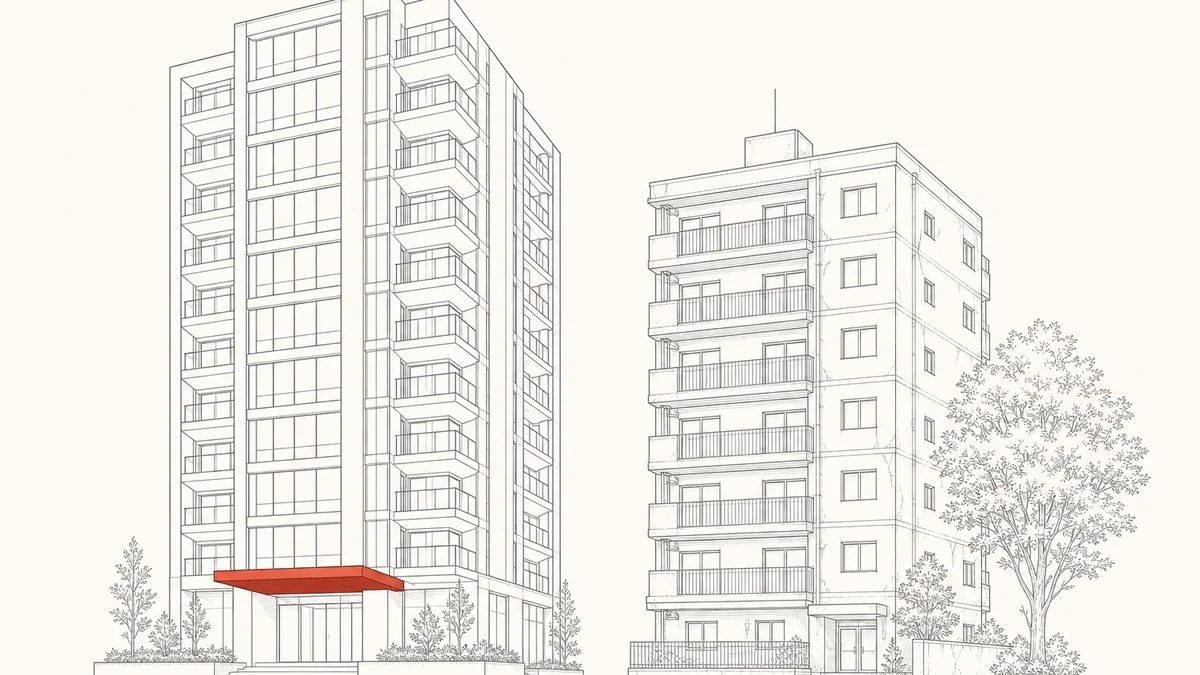
The vocabulary first: shinchiku and chuko
In Japanese real estate listings, shinchiku (新築) means new construction — a property that has not been previously owned or lived in, typically sold by the developer or a developer-affiliated sales company. Chuko (中古) means secondhand: a property that has been previously registered in someone's name, even if it was never actually occupied. This distinction matters more than it might seem, because the legal definitions affect how each is taxed, how commissions are structured, and what disclosure obligations apply to the seller.
In practice, Tokyo's property market has abundant supply of both. New condominium towers continue to be completed in redevelopment zones around major stations. At the same time, the secondhand stock has grown substantially over recent decades, and there are now well-developed mechanisms — though not yet seamlessly foreigner-friendly ones — for evaluating older properties before purchase.
The 1981 line and why structural standards matter more in Japan
Japan sits on one of the most seismically active pieces of land on earth, and its building codes have evolved significantly as a result. The most important date in this history for a condo buyer is 1 June 1981, the day a Cabinet Order amending the Enforcement Order of the Building Standards Act (建築基準法施行令) took effect and introduced what is called the shin taishin kijun — the new seismic resistance standard. Note that the change was made at the level of the Enforcement Order, not the Act itself. Buildings designed under this standard are required to withstand earthquakes of a different magnitude than those designed under the pre-1981 rules.
A second line falls on 1 June 2000, when the specification requirements for wooden houses were clarified — the specification of structural joints, and the placement of load-bearing walls under the so-called four-quadrant method. That line matters mainly for wooden houses (戸建て); condominium buyers are generally more focused on the 1981 line. As for why the design-approval date matters at all when you are looking at concrete and steel: in a comprehensive post-quake survey of a designated area of Kobe's Chuo ward after the 1995 Hanshin earthquake, the Building Research Institute recorded collapse or total failure in 17% of buildings dating from 1971 or earlier, against 5% for 1972–1981 and 3% for 1982 onward.
For a foreign buyer, this is usually most relevant when looking at chuko apartments. A secondhand property built before June 1981 — or more precisely, one whose building permit was approved before that date — is described as meeting the old standard (旧耐震基準). Most Japanese lenders apply stricter conditions to pre-1981 properties, and some will not lend against them at all. If you are planning to finance with a Japanese mortgage, this is a practical constraint worth verifying with your lender before you fall in love with a particular building.
Structural standard checklist for secondhand buyers
- Ask your agent for the year the building permit (建築確認) was approved, not the year construction completed — the permit date determines which standard applies.
- Check whether the building has undergone a seismic retrofit assessment (耐震診断) or structural reinforcement works (耐震補強). Many buildings have, and results are sometimes posted in the building's common areas.
- If you are applying for a Japanese mortgage, confirm with your lender early whether the building's permit date affects loan eligibility or terms. This varies by financial institution.
- For buildings completed after 2000, ask whether the building holds a Housing Performance Evaluation (住宅性能評価) certificate, which provides a standardised assessment across several categories including seismic resistance.
What you actually pay for with a new build
A new condominium in Tokyo typically sells at a premium above the land value and construction cost — a premium that includes the developer's margin, the model room and sales operation, the marketing, and in many cases, the brand attached to the development. This is not a criticism: the warranty coverage, the new mechanical systems, and the absence of repair surprises are genuine value. But it is useful to understand what portion of what you are paying is durable and what portion is the new-car effect.
New builds come with a statutory 10-year structural defect warranty (瑕疵担保責任), which in practice means the developer is obligated to remedy structural and waterproofing defects discovered within ten years. This is a legal minimum; some developers offer extended coverage on specific systems. This warranty does not transfer in a way that would protect a subsequent buyer who purchases the property after it has been occupied — once a property has been registered in someone's name and resold, it becomes chuko, and the remaining term of the original warranty may or may not be enforceable by the new owner depending on how the contract is written.
New builds are also typically sold without the ability to negotiate significantly on price. The developer sets the price schedule; discounts on remaining units in slower-moving projects exist but are not the norm in Tokyo's more central locations. Agents handling new builds are generally working for the developer or on the developer's commission structure, which is a different arrangement from the bilateral agent relationship in a secondhand purchase.
Secondhand's real advantages: location, character, and what you can actually see
The case for secondhand is not primarily about price — though entry prices in chuko condos in desirable locations can be meaningfully lower than comparable new builds. The more underappreciated advantage is access.
Many of Tokyo's most liveable pockets — the parts with mature zelkova trees lining the streets, the neighbourhood shotengai shopping arcade, the established coffee shops that have been there long enough to have a regular crowd — were built out decades ago. New development tends to concentrate near newly elevated station areas, logistics corridors, and the edges of existing commercial zones. If you want to live in a particular established neighbourhood rather than in a district that is becoming something, the chuko market is usually where those properties are.
There is also something to be said for buying a property whose existing condition is apparent. A new build shows you what the developer chose; the floor plan and fixtures are fixed. A secondhand apartment shows you what the previous owner did with the space, sometimes poorly, sometimes in ways that turn out to suit you more than a developer's standard layout would. The 重要事項説明書 (Important Matters Explanation) that an agent must deliver before a secondhand purchase is legally required to disclose known defects, renovation history, and certain building conditions. Reading it carefully — with translation help if needed — tells you more about a specific property than a developer's glossy brochure.
The inspection gap: how chuko properties are assessed in Japan
Japan introduced mandatory home inspection (住宅インスペクション) disclosure requirements for secondhand real estate transactions in 2018, when the Real Estate Transaction Act was amended. Since then, agents are legally required to explain whether an inspection has been carried out on the property, and if so, to share the results as part of the 重要事項説明 process. This is progress, but it is not the same as mandating that an inspection has actually been done.
In practice, many secondhand condominiums in Tokyo are still transacted without an independent inspection. The disclosure obligation covers whether an inspection exists, not whether one is required. As a buyer, you have the right to commission your own inspection, and for a significant purchase, doing so is generally advisable. The inspection that the Real Estate Transaction Act refers to is carried out by an 既存住宅状況調査技術者 — in MLIT's own definition, a licensed architect (建築士) who has completed the state-registered course for existing-housing condition surveyors. There is no official English title; "home inspector" is an approximation. Finding an inspector who can also communicate in English — or through a bilingual intermediary — adds a layer of complexity, but not an insurmountable one.
Inspection checklist for secondhand buyers
- Ask your agent at the outset whether a 住宅インスペクション has been completed on any property you are seriously considering. If so, request the results as part of the 重要事項説明 materials.
- If no inspection has been done and the property is a significant purchase, ask whether the seller will agree to one before contract. Not all sellers will; some will factor a buyer-commissioned inspection into negotiation instead.
- For condominiums, the inspection is necessarily limited to the interior of the unit and what is accessible from it. The building's common areas, structural elements, and mechanical systems are managed by the management company and the condominium association (管理組合) — ask your agent for the 管理状況確認書 (management status document) and review the repair reserve fund (修繕積立金) balance.
- Check how long the property has been on the market and whether the asking price has changed. This context is helpful, though property price negotiations in Japan operate somewhat differently from auction-style markets — ask your agent for their read on the seller's position.
Depreciation, resale, and the question foreigners rarely ask soon enough
Japanese condominiums (マンション) have a statutory useful life for tax purposes. Under Japan's tax code, the standard depreciation period for a concrete structure — which is what most Tokyo condos are — is 47 years. This figure affects how the tax authorities calculate the residual value of a building for various purposes, including income tax on rental income if you rent the property, and the calculation of acquisition cost for capital gains when you sell.
For a foreign buyer who is also considering the property as a future investment or who may eventually sell to return overseas, the depreciation schedule matters. Here the arithmetic is not the obvious subtraction. A brand-new build starts with 47 years. But when you acquire a used building and put it to business use — renting it out, for instance — the NTA's simplified method (簡便法) for used assets sets the useful life at the statutory life minus the elapsed years, plus 20% of the elapsed years. For a 30-year-old concrete building that is (47 − 30) + (30 × 0.2) = 23 years, not the 17 years a plain subtraction would suggest. Owner-occupied property is calculated differently again, which is one more reason the schedule is worth asking about rather than assuming. This does not mean the older building is a bad purchase — the land component does not depreciate, and in central Tokyo the land value often accounts for a substantial portion of the total — but the tax treatment of the building component when you come to sell is something to discuss with a Japanese tax accountant before you sign, not after.
For foreign nationals specifically, there are additional considerations around capital gains tax on property sold while living outside Japan (or after leaving Japan), as well as withholding at the point of sale: where a non-resident sells land or a building in Japan, the buyer is generally required to withhold 10.21% of the sale proceeds and remit it to the tax office, the exception being an individual buying the property as a home for themselves or a relative at a price of 100 million yen or less. These rules are detailed, they change, and they depend significantly on your individual residency history and tax status. General articles — including this one — cannot substitute for advice from a professional who knows your situation.
What to ask before you decide
The new build versus secondhand question tends to resolve itself once you define what you actually want — and once you look honestly at what your financing situation allows.
If your priority is minimising early repair uncertainty, a new build with full warranty coverage removes most of that risk for the first decade. The trade-off is the developer premium and less flexibility on location.
If your priority is a specific neighbourhood, chuko is almost certainly where the supply is. The inspection and structural check steps add some effort, but they are manageable with the right agent and, where warranted, an independent inspector.
If financing is a binding constraint, verify with your lender whether the building's permit date affects loan terms before you narrow your search to pre-1981 buildings. Some lenders are flexible; others are not.
If you have a medium-term exit in mind, speak to a tax professional about how the depreciation schedule and your residency status at the time of sale will affect your capital gains position — before you choose, not after.
What tends to go wrong in this decision is not choosing the wrong property type per se, but narrowing the question before the supporting questions have been answered. A well-located chuko apartment that passes an inspection and suits your financing terms is a sounder purchase than a new build in an area you wouldn't otherwise have chosen. The reverse is also true.
If you haven't already read our guide on the full purchase process, that's the logical next step after forming a general preference on property type — it covers how the offer, contract, and registration work in Japan, and where the decision points are for foreign buyers:
- How to Buy Property in Japan — step-by-step from offer to title registration
- Japan Mortgage for Foreigners — eligibility, documents, and what lenders actually look at
- Can Foreigners Buy Property in Japan? — ownership rights, visa status, and land restriction points
- Reading a Japanese Floor Plan — decoding 1LDK notation and apartment layout logic before your first viewing
References
- Ministry of Land, Infrastructure, Transport and Tourism (MLIT) — “インスペクション(建物状況調査)について”: the 2018-04-01 amendment, the three obligations it imposes on agents, and the definition of 既存住宅状況調査技術者. mlit.go.jp — inspection. Accessed 2026-07-30.
- MLIT — “住宅・建築物の耐震化について” (old vs. new seismic standard). mlit.go.jp — 耐震化. Accessed 2026-07-30.
- Building Research Institute — 「新耐震基準」から40年を振り返る (1981-06-01 enforcement of the amended Building Standards Act Enforcement Order; Kobe Chuo-ward damage survey by construction year). kenken.go.jp (PDF). Accessed 2026-07-30.
- Japan Building Disaster Prevention Association / MLIT — 新耐震基準の木造住宅の耐震性能検証法 (the 2000-06-01 clarification of wooden-house specifications: structural joints and the four-quadrant method). mlit.go.jp (PDF). Accessed 2026-07-30.
- MLIT public notice — 宅地建物取引業者が宅地又は建物の売買等に関して受けることができる報酬の額 (Construction Ministry Notice No. 1552 of 1970, last amended by MLIT Notice No. 949 of 21 June 2024, in force 1 July 2024): the 5.5%/4.4%/3.3% tiers and the 8-million-yen / 300,000-yen exception. mlit.go.jp (PDF). Accessed 2026-07-30.
- e-Gov — 住宅の品質確保の促進等に関する法律 (Housing Quality Assurance Act), Articles 94–95: the ten-year liability for defects in structurally critical parts and rain-penetration-prevention parts, running from delivery. laws.e-gov.go.jp. Accessed 2026-07-30.
- National Tax Agency (NTA) — No.5404 中古資産の耐用年数 (simplified method for used assets). nta.go.jp No.5404. As of 2026-07-30.
- NTA — 主な減価償却資産の耐用年数表 (reinforced concrete: 47 years residential, 50 years office). nta.go.jp (PDF). As of 2026-07-30.
- NTA — No.3202 譲渡所得の計算のしかた(分離課税): acquisition cost of a building is net of accumulated depreciation. nta.go.jp No.3202. As of 2026-07-30.
- NTA — No.2879 非居住者等から土地等を購入したとき: 10.21% withholding by the buyer, with an exemption for individuals buying a home for their own or a relative's residence at 100 million yen or less. nta.go.jp No.2879. As of 2026-07-30.