This article may contain affiliate or sponsored links. Listing order is not a ranking or endorsement. See footer for details.
Can Foreigners Buy Property in Japan? Yes, But Read the Fine Print
The legal answer is simple enough: foreign nationals can generally own property in Japan. The practical answer is slower.
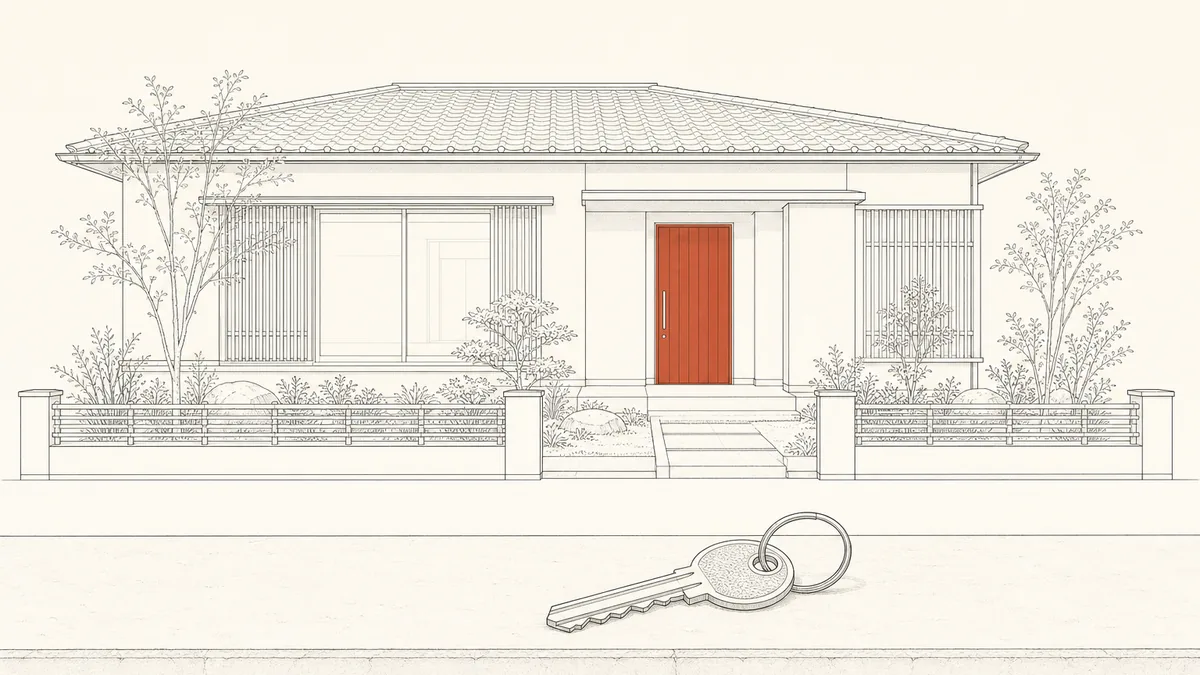
No nationality restriction on ownership
Start with what the law actually says, because it is shorter than most discussions of it. No nationality test, visa, or residency status stands between a foreign buyer and ownership of Japanese real estate: any person, of any nationality, can buy land, a building, or both, and hold freehold title (所有権) in their own name. Once registered, a foreign owner's rights over the property are the same as a Japanese citizen's — the right to use it, lease it, sell it, or leave it to an heir.
This surprises people who half-expect real estate to work like immigration: earn enough points, hold the right visa, then qualify. It doesn't. The two systems are unrelated, which leads to the next thing worth stating plainly.
Buying property does not buy you a visa
Japan has no investment-residency or "golden visa" program tied to property purchase. There is no such category on the Immigration Services Agency's list of statuses of residence; the closest thing, "Business Manager" (経営・管理), is defined by operating or managing a business in Japan, which owning a property is not. Buying an apartment, a house, or a piece of land has no bearing on your immigration status. If you already hold a visa that lets you live in Japan, owning property doesn't change its terms. If you don't, owning property doesn't create one. Anyone weighing a purchase partly as a route to residency should treat that idea as settled: it isn't a route, at least not through the property itself.
Why the practical answer is slower
If ownership itself isn't restricted, why do foreign buyers so often describe the process as harder than expected? Mostly because the friction sits elsewhere — in financing, documentation, and a transaction process built around assumptions that don't always match a buyer arriving from abroad.
Japanese mortgage lenders assess foreign applicants more cautiously than domestic ones, and terms vary considerably by institution, by visa status, and by how long you've been resident, if you're resident at all. Non-resident buyers should expect domestic financing to be harder to arrange and may end up financing from their home country instead. None of this is a legal barrier to ownership. It's a lending decision, made loan by loan.
Then there is paperwork with no obvious foreign equivalent to fall back on: a registered seal (実印) and its certificate, a residence record, sometimes a guarantor or a local bank account opened before the purchase can close. None of these steps is difficult on its own. Stacked together, without someone to translate the sequence, they are what actually slows a purchase down — not any rule that singles out foreign buyers for exclusion.
Freehold and leasehold: two different things you can buy
Japanese listings distinguish between two forms of tenure, and it is worth knowing which one you're looking at before you get attached to a property.
Freehold (所有権) means you own the land and the building outright. There is no expiry on the ownership, and you are free to sell it, gift it, or leave it to your heirs without anyone else's involvement.
Leasehold (借地権) means you own the building but lease the underlying land from its owner. The arrangement sits under the Land and Building Lease Law (借地借家法), which defines a 借地権 as a superficies or land lease held for the purpose of owning a building, and which is the source of the landowner's involvement in the decisions that matter most later. Rebuilding beyond the remaining term extends the lease only with the landowner's consent (Article 7); where a lease condition restricts rebuilding or extension, a court can substitute its permission for the landowner's (Article 17); and the same substitution exists when a landowner unreasonably refuses consent to a transfer of the building and lease to a third party (Article 19). The law does not fix the ground rent, but it does govern how it moves: either side can demand an increase or reduction when taxes, land values, or comparable local rents have made the current figure unreasonable (Article 11). Leasehold listings typically carry a lower upfront cost than an equivalent freehold property, offset by the ongoing ground rent and the landowner relationship that comes with it.
Foreign buyers are free to purchase either. The choice is less about eligibility and more about which trade-off suits your plans for the property: full independence, or a lower entry cost paired with an ongoing landlord relationship.
The professionals who carry the paperwork
Two licensed roles do most of the structural work in a Japanese property purchase, and knowing what each one is legally required to do makes the process considerably less opaque.
Before you sign a sales contract, a licensed real-estate transaction agent (宅地建物取引士, 宅建士) must deliver an Explanation of Important Matters (重要事項説明) — a document covering the property's legal status, its condition, and the terms of the transaction. This is not a courtesy extended by careful agents; it is a statutory duty under Article 35 of the Building Lots and Buildings Transaction Business Act (宅地建物取引業法). An agent who skips it or rushes through it is not meeting that obligation, whoever the buyer happens to be.
Separately, the transfer of ownership is registered at the Legal Affairs Bureau (法務局), and that registration (登記) is handled by a licensed judicial scrivener (司法書士) — the same professional, doing the same job, whether the buyer is Japanese or not. There is no separate registration track for foreign owners.
Taxes apply the same way, wherever you live
Two ownership taxes attach to Japanese real estate, and neither depends on the owner's nationality or country of residence. A one-time Real Estate Acquisition Tax (不動産取得税) is assessed when you take ownership. After that, an annual Fixed Asset Tax (固定資産税) applies for as long as you hold the property, plus a City Planning Tax in some municipalities. Rates and calculation methods vary and change, so treat any figure you come across as a starting point for a conversation with a professional, not a number to budget against directly.
The one genuine complication for owners who live outside Japan: without a Japan address, you need to appoint a Japan-resident Tax Agent (納税管理人) to receive tax notices and handle filings and payments on your behalf. This is an administrative requirement, not a workaround for some restriction on non-resident ownership. It exists because the tax office needs someone reachable inside Japan, and an owner living abroad, by definition, is not.
There is also a reporting obligation that catches non-resident buyers off guard, and it is more routine than most summaries suggest. Under the Foreign Exchange and Foreign Trade Act (外為法), a non-resident who acquires real estate in Japan — or a right over it, such as a leasehold or a mortgage — must file a "Report on the Acquisition of Real Estate or Rights Thereto in Japan" (Form 22) with the Minister of Finance via the Bank of Japan within 20 days of the acquisition. The Ministry of Finance is explicit that there is no de minimis threshold: "a report is required regardless of the size of the amount or the area." A resident agent can file it for you, and it can be submitted online.
The scope of that duty was widened for acquisitions dated 1 April 2026 or later. Before that date, only property acquired for investment and similar purposes was reportable; from that date the report is required whatever the purpose of the acquisition, and one of the previous exemptions — property acquired from another non-resident — was removed. A narrow set of carve-outs survives, covering certain rights acquired for the buyer's own residence, for non-profit business use, or for the buyer's own office; the Ministry notes that where the real estate itself is acquired, the report is still required. The new form also asks for the counterparty, the purpose of the acquisition, and the property number. Failing to file, or filing a false report, is punishable by up to six months' imprisonment or a fine of up to ¥500,000 (外為法 Article 71). Ask whoever handles your closing who is filing this and when — it is not part of the registration your judicial scrivener does.
A security law that sounds scarier than it is
Buyers occasionally come across mentions of a Japanese law restricting land near military bases or national borders and worry it amounts to a foreign-ownership ban in disguise. It doesn't work that way.
The law in question is 重要土地等調査法, promulgated on 23 June 2021 as Act No. 84 of that year — in full, the Act on Investigation and Regulation of the Use of Land Surrounding Important Facilities and on Remote Territorial Islands. It lets the government designate zones around facilities it considers critical — Self-Defense Force and US military bases, coast guard sites, nuclear plants — as well as certain border islands, survey how land in those zones is used, and restrict uses that would impair the facility. It applies to every owner and user of land in a designated zone, Japanese and foreign alike, and the Cabinet Office publishes each designation by notification.
One part of it does reach the transaction itself, and it is worth knowing before you make an offer. Inside the stricter class of zone — a Special Alert Zone, 特別注視区域 — a contract transferring ownership of land or a building above a size threshold set by cabinet order (the Act requires that threshold to be no smaller than 200 m², measured as floor area for buildings) triggers a notification duty. Article 13 puts it on "the parties", which the Cabinet Office spells out as both the seller and the buyer, and the notification must in principle reach the Prime Minister before the contract is concluded; where the contract arises from court mediation and similar causes, it is filed within two weeks afterwards instead. Concluding a covered contract without notifying carries up to six months' imprisonment or a fine of up to ¥1 million.
None of that is a foreign-ownership ban, and none of it singles out foreign buyers — the duty falls on Japanese sellers and buyers in exactly the same terms. But it is a real obligation attached to real, published locations, so if a property you like sits near a base, a nuclear plant, or on a border island, ask your agent to check the designation before you write the offer rather than after. For the large majority of residential and investment purchases, it never comes up at all.
Before you sign anything
None of this changes the shape of the original answer. Foreign nationals can own property in Japan, freehold or leasehold, with the same rights a Japanese owner holds. What takes time is everything around the ownership question — financing, the document trail, the tax filings if you live abroad — and none of it requires anything more exotic than patience and the right professionals.
This article describes how the system generally works, not how your specific purchase will unfold. Laws, tax treatment, and lending practice change, and your own situation — visa status, residency, financing source, the property itself — will shape which parts of this matter most. Before you commit to anything, verify current rules with the licensed 宅建士 handling the transaction and, separately, with a tax or legal professional who can look at your circumstances directly.
References
- Ministry of Finance, 非居住者による本邦の不動産等取得に係る報告 — 制度の概要 — the 20-day filing deadline and the route via the Bank of Japan. mof.go.jp. Accessed 2026-08-01.
- Ministry of Finance leaflet (dated June 2026), 外為法に基づく「本邦にある不動産又はこれに関する権利の取得に関する報告書」の提出 (PDF) — states that a report is required "regardless of the size of the amount or the area", and sets out what changes for acquisitions dated 1 April 2026 or later. mof.go.jp (PDF). Accessed 2026-08-01.
- e-Gov Japan, 外国為替及び外国貿易法 (Foreign Exchange and Foreign Trade Act), Act No. 228 of 1949 — Article 71 sets the penalty for failing to report or reporting falsely. laws.e-gov.go.jp. Accessed 2026-08-01.
- e-Gov Japan, 重要施設周辺及び国境離島等における土地等の利用状況の調査及び利用の規制等に関する法律, Act No. 84 of 2021 — Article 13 (notification duty in a Special Alert Zone) and Article 26 (penalties). laws.e-gov.go.jp. Accessed 2026-08-01.
- Cabinet Office, 区域の指定について — confirms that both seller and buyer must notify, and lists each designation notification. cao.go.jp. Accessed 2026-08-01.
- e-Gov Japan, 借地借家法 (Land and Building Lease Law), Act No. 90 of 1991 — Articles 2, 7, 11, 17 and 19. laws.e-gov.go.jp. Accessed 2026-08-01.
- Immigration Services Agency, 在留資格一覧表 — the status-of-residence list, on which "Business Manager" requires operating or managing a business. moj.go.jp/isa. Accessed 2026-08-01.
- e-Gov Japan, Building Lots and Buildings Transaction Business Act (宅地建物取引業法), Act No. 176 of 1952 — Article 35 is the source of the Important Matters explanation. laws.e-gov.go.jp/law/327AC1000000176. Accessed 2026-08-01.
- JETRO (Japan External Trade Organization), Investing in Japan portal. jetro.go.jp/en/invest. Accessed 2026-08-01.