This article may contain affiliate or sponsored links. Listing order is not a ranking or endorsement. See footer for details.
Picturing Daily Life in a Tokyo Neighborhood Before You Sign
The listing said six minutes to the station. That was measured on a dry Tuesday at midday, without bags. You would be walking it on a wet Thursday evening with a week's worth of groceries and a bag over your shoulder. That gap between the number and the experience is where most neighborhood decisions go wrong — and it is entirely fixable with a few unhurried visits.
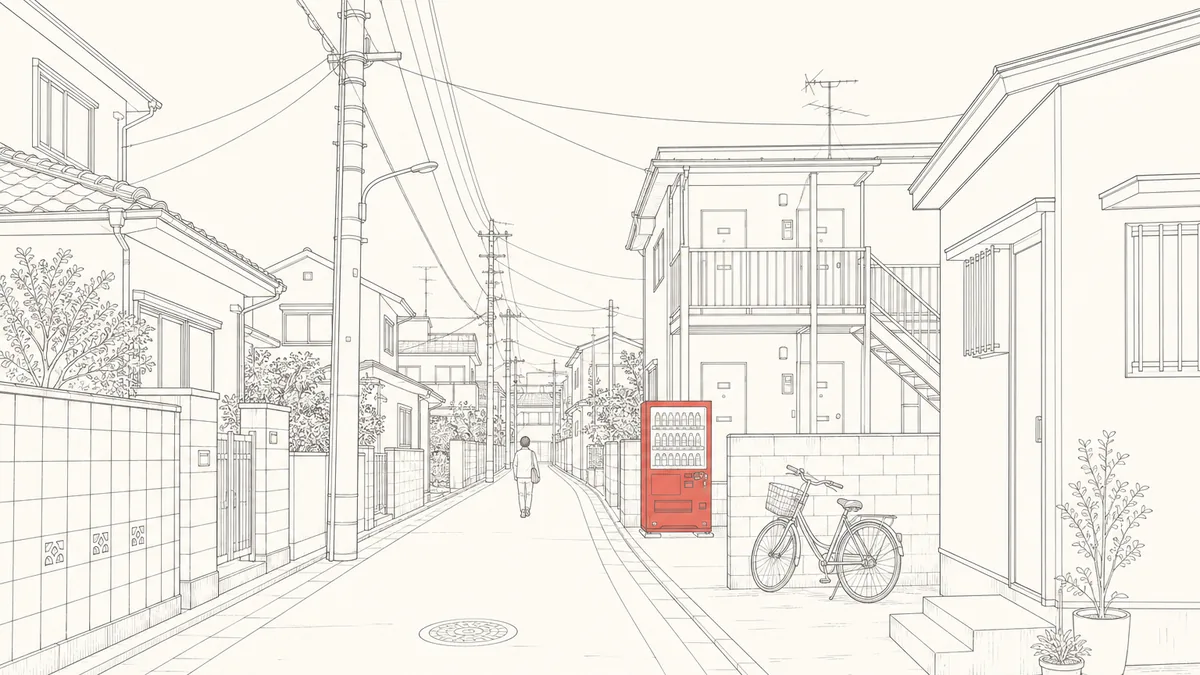
What the station walk actually tells you
Rental and property listings in Japan measure the station walk under an industry fair-competition code, and the code is more specific than most readers assume. For an apartment building the measurement starts at the building's entrance. It ends at the station's entrance — not at the ticket gate — and it is road distance, calculated at 80 metres per minute, with any fraction of a minute rounded up to a whole one. This is a standardised measurement, not a description of your commute, and the gap between the two starts before you have even entered the station: whatever it takes you to walk from the station entrance through the concourse to the gate is time the listing never counted.
In practice, the route may involve a pedestrian underpass that closes after midnight. It may include a slope that is manageable on a clear evening but becomes cautious work in rain boots. Some buildings that list "7 minutes" to a station put you at a quieter exit, and the grocery store or the supermarket you will actually use is near the busier one, adding three or four minutes in the opposite direction. None of this is concealed — it simply is not in the listing.
The walk also reveals rhythm. How many other people are using it at the time you would be? Is there a covered shopping arcade along part of it, or is it open road? Are there enough lights after dark? These are the sorts of things that become obvious when you walk the route yourself, twice, at the times you would actually be using it.
Station walk checklist
- Walk the route at the times you would use it most — morning commute hour and evening return, not midday on a weekend.
- Walk it with a bag or shopping equivalent. Note whether there are stairs without escalators, or slopes that would be uncomfortable in wet weather.
- Check whether the most convenient exit is the one closest to the building, or whether the supermarket, pharmacy, and other regular destinations are near a different exit.
- Note what closes along the route by 9pm — some covered arcades and smaller shops have earlier hours than convenience stores.
- If the building is near an underpass or a footbridge, check whether it has restricted hours (some close between midnight and early morning).
What the entrance and mailbox tell you before you sign
Stand at the entrance of a building you are seriously considering and give it five minutes. What you are looking at is a record of management style and language accessibility — two things that matter a great deal once you are actually living there.
The notice board near the entrance is usually where the building manager or management company posts announcements: upcoming inspections, changes to the garbage schedule, noise reminders, maintenance works. In most buildings in Tokyo, these notices are in Japanese only. That is standard and not a problem if you have a bilingual contact at the management company or a landlord who communicates with you in English. It becomes a friction point if you are expected to act on notices you cannot read without asking for help each time.
The garbage schedule deserves particular attention. Waste sorting rules in Tokyo are serious — burnables on certain days, recyclables on others, oversized items by arrangement only. The schedule is usually posted near the collection point in the building, and non-compliance can result in your bag being left uncollected with a sticker attached, which is more embarrassing than it sounds in a building where everyone uses the same corner. Some buildings have clear pictogram charts that anyone can follow. Others have dense text. Worth noting before you move in.
The mailboxes — labelled or not, orderly or taped-over — tell you about occupancy turnover. A row of unlabelled boxes suggests either high turnover or people who prefer not to identify themselves, which can mean either thing. A building where several residents have put up small handwritten labels, sometimes in two languages, is usually one where people stay a while.
Entrance and building checklist
- Read the notice board. Is there anything in English, or only Japanese? If you cannot read any of the notices, ask your agent how the management company communicates with foreign residents.
- Find the garbage collection point and check whether the sorting rules are presented clearly enough to follow without translation help.
- Look at the intercom system — does it have a camera? Is the label panel legible and in reasonable condition?
- Check communal areas (lift, corridor, bicycle lot) for general maintenance level. Not aesthetics — maintenance. Burnt-out corridor lights that have been there a while tell you about response time.
- Ask your agent whether the management company (管理会社) accepts communication in English, or has a contact who speaks English, even for routine matters.
The quiet-street vs convenient-street trade-off — and why only you can resolve it
Picture two apartments that both come up in the same search. Neither is a real listing — they are generalised types that appear in Tokyo across many different areas.
Type A is seven minutes from a major circular-line station. The route goes through a covered shopping arcade with a supermarket, a pharmacy, and several restaurants. Noise from the arcade reaches the lower floors until about 10pm. The station itself handles a high volume of transfers, and late-night trains run until just after midnight.
Type B is twelve minutes from an express stop on a private railway line in a more residential pocket. The surrounding streets are mostly single-family houses and low-rise apartments. The elementary school is two blocks away. The street is quiet by 9pm, and a small park sits at the end of the road. The nearest large supermarket is a ten-minute cycle or a short bus ride.
Type A suits someone whose work hours are irregular, who values the ability to run an errand at 9:30pm, and who eats out more often than cooking. Type B suits someone who prefers a more residential pace, whose household runs on a regular morning and evening schedule, and who does not mind the longer reach to shopping. Neither is objectively better. The answer depends on which day-to-day life you are planning to live in that apartment, not on which one photographs better.
The problem is that a listing photo does not tell you which type you are looking at — and neither does a single visit on a Sunday afternoon, when Tokyo is at its calmest. You need to visit at least twice: once during weekday hours, and once on a weekday evening.
Neighbourhood rhythm checklist
- Visit on a weekday morning around 7:30–8:30am. Note whether there is noise from a school run, a market opening, or delivery vehicles. This is often the loudest domestic hour.
- Visit on a weekday evening around 9–10pm. Walk the street, listen from outside the building. Near an express railway line or a main road, the sound profile at this hour is very different from midday.
- Find the nearest place to buy food on a Sunday evening. If it is only a convenience store, ask yourself whether that suits how your household operates week-to-week.
- Note whether there is a nearby elementary school (小学校) or park — these areas are generally well-maintained and have lower late-night noise, but they can also mean a busy 8am on weekdays.
- Ask the agent how long the previous occupant lived there. A building where most residents stay two or more years is usually one where the daily realities are broadly acceptable.
The guarantor form and the language barrier at sign-up
This section is about renting. If you are primarily investigating purchase, you can skip to the next section — though the language-friction points apply there too, in a different form.
Expect to be asked for a guarantee of some kind: an MLIT review of the rent-guarantee market found that around 97% of leases required one. Increasingly that guarantee comes from a 保証会社 (hoshō gaisha), a guarantor or surety company, which effectively co-signs the lease and covers the landlord if you default on rent. The ministry put guarantor-company use at roughly six in ten leases in its mid-2010s figures, and rising since. Note the shape of that number, though: it is national rather than Tokyo-specific, it is now some years old, and it does not mean personal guarantors have gone away — a substantial share of leases still used a personal guarantor, alone or alongside a company. Which arrangement applies to you is a question for the specific property. The management company or landlord typically has a relationship with a specific guarantor company, and you will not usually be offered a choice.
The guarantor company's application form is almost always in Japanese. It will ask for: your full name (in the format they require — usually katakana for foreign names), your current address, your employer's name and address, your annual income, your emergency contact in Japan, and sometimes an emergency contact in your home country. It may also ask for the number on your residence card (在留カード) and the status of residence you hold. A note on the vocabulary, because older guides still get it wrong and the form may too: there is no longer any such thing as an alien registration number. The residence card replaced the old alien registration certificate, and the number the form wants is the card's number. This is a routine procedural form. It is not a credit check in the Western sense, though some companies do look at Japanese credit records if you have any.
Where things slow down is when you need to ask questions about the form, or when something on it does not fit your situation — for example, if you are self-employed, on a spouse's dependent visa, or have recently changed jobs. These are solvable situations, but they are easier to navigate when your agent speaks both languages and knows how to present your documentation clearly.
If you are buying rather than renting, the equivalent document is the 重要事項説明書 (Important Matters Explanation), a legally required disclosure document that a licensed 宅建士 must deliver and explain to you before you sign any purchase contract. It does not have to happen in the same room: for sale transactions the remote video version (IT重説) has been in full operation since 30 March 2021, and since 18 May 2022 the document itself may be provided electronically where you have consented. This document covers the property's legal status, zoning, building conditions, and known issues. It is not legally required to be provided in English. Some agents provide bilingual summaries alongside it; confirm this before you select your agent, not after you have found the property you want.
Language and documentation checklist
- Before you start seriously viewing properties, ask your agent whether they regularly handle foreign national applications with your specific residency status (permanent resident, work visa, spouse visa, etc.).
- Ask which guarantor company or companies are associated with properties you are considering, and whether those companies have experience with foreign national applicants.
- Prepare standard documents in advance: your residence card (在留カード), proof of employment or income (or equivalent for self-employed), and contact details for your emergency contact in Japan.
- If you are buying: confirm with your agent whether they will provide a bilingual summary of the 重要事項説明書, and how much time you will have to review it before the scheduled signing.
- Ask the agent directly whether the management company communicates with foreign residents in English for routine matters (not just at sign-up, but for ongoing maintenance requests and notices).
Four checks to do before you contact an agent
These are things you can verify yourself, without a viewing appointment, for any neighbourhood you are seriously considering. They are not substitutes for professional advice, but they give you better questions to ask.
1. The grocery run
Identify the nearest full-service supermarket — not a convenience store — and check its opening and closing hours. Many Tokyo supermarkets close between 9pm and 11pm; some close earlier. If your schedule means you regularly shop after 8pm, this matters. Google Maps is accurate enough for this purpose if you search by neighbourhood name. Note the nearest 24-hour convenience store as well, but understand that it is a supplement, not a substitute for a weekly household shop if you cook regularly.
2. English-language medical access
Tokyo has a reasonable number of clinics and hospitals with English-speaking staff, but they are not evenly distributed. If you have a pre-existing condition that requires ongoing care, or if you have children who are likely to need a paediatrician, checking the distance and access to an English-capable medical facility is practical due diligence. The Tokyo Metropolitan Government's multilingual medical institution search is a useful starting point; your embassy or consulate may also maintain a list of recommended providers.
3. The hazard map
There is no single Tokyo-wide hazard map, and expecting one is the first thing that slows people down. Hazard maps for flooding, inland flooding, landslide and storm surge are drawn by each ward, city, town and village; the Tokyo Metropolitan Government's disaster-preparedness site is the entry point that routes you to the right municipality's map, and the Bureau of Construction keeps the index of published landslide hazard maps. Liquefaction sits somewhere else again — the Metropolitan Government publishes a separate liquefaction prediction map, and its methodology pages exist in English as well as Japanese. If you would rather start from one screen, the national Hazard Map Portal layers several of these together and can be searched by address. The interfaces are mostly Japanese, but the overlays are colour-coded and legible once you know what you are looking at. Be precise about what the law actually obliges an agent to do here, because it is easy to over-read. Since 28 August 2020, the required explanation before a contract — for rentals as well as sales — is that the agent produces the municipality's flood hazard map and shows you roughly where the property sits on it. That is a duty to place the property on a map. It is not a duty to tell you whether this particular building has flooded before. Checking the map yourself, early, is how you arrive at that conversation already knowing what you are looking at. Checking it for a neighbourhood you are seriously considering costs nothing and takes about five minutes.
4. Noise at night
Visit after 9pm on a weekday. Stand outside the building for a few minutes. Near an elevated rail line, the sound of a passing express train is quite different from the background hum during the day. Near a highway, the night profile sometimes carries further than the daytime one. This is not a safety concern — it is a sleep and comfort one. If you are a light sleeper, it is the check that most reliably predicts whether you will be happy there six months in.
Pre-contact due-diligence checklist
- Grocery: identify the nearest full-service supermarket, check hours, and note whether it is walkable or requires a bus or bicycle at the time you would normally shop.
- Medical: locate the nearest clinic or hospital with English-speaking staff and check whether it covers your most likely needs (general practice, paediatrics, dentistry).
- Hazard map: look the neighbourhood up and note whether it falls inside a flood, landslide or liquefaction zone. Start at the national Hazard Map Portal, which is searchable by address, or at the Tokyo Metropolitan Government's guide to finding your municipality's hazard map; liquefaction is mapped separately by the Metropolitan Government's liquefaction prediction map, whose methodology pages are also in English.
- Night visit: go after 9pm on a weekday and spend five minutes outside the building before you leave. Note rail noise, road noise, and street activity level.
Rent now, buy later — letting daily-life questions guide the timing
This guide has focused on renting because renting is usually the first encounter with a neighbourhood. But the questions it raises are also useful for people who are considering buying, and they connect directly to when and whether to make that move.
If you are new to Tokyo — or new to the specific area you are considering — renting for a defined period before buying gives you something that no amount of research can fully replace: actual experience of the daily routine in a real property in that neighbourhood, through different seasons and different life events. Many foreign buyers who have purchased in Tokyo will say that their second instinct about an area was more accurate than their first. Renting first, even for twelve to eighteen months, tends to shorten the decision time once you are ready to buy, because you are no longer deciding based on abstractions.
If you have already rented in a neighbourhood and found that the daily life suits you, the next set of questions — about ownership rights, the purchase process, and financing — are covered in our other guides:
- Can Foreigners Buy Property in Japan? — ownership rights, visa considerations, and what actually limits foreign buyers
- How to Buy Property in Japan — the full step-by-step process from offer to title registration
- Japan Mortgage for Foreigners — who qualifies, what documents are needed, and what to expect from Japanese lenders
When the purchase decision comes into range, financing is usually the point where professional guidance matters most. The eligibility criteria that Japanese banks and lenders apply to foreign national applicants vary, and they depend on residency status, employment type, and the specific lender — not on a general rule you can rely on from an article.
Before the search, the picture
The listing photo showed the south-facing window and the clean kitchen counter. It did not show the Tuesday evening with the grocery bags, or the smell from the restaurant exhaust below, or the neighbour who leaves a bicycle in the space that is technically already full. None of these are problems you can solve by reading — they are things you find out by visiting, more than once, at different hours, with a specific set of questions.
Once you have visited with those questions, you can build a checklist. And once you have a checklist, you are choosing rather than hoping. That is a meaningfully different position to be in before you put your name on anything.
All of the above is general context. For your specific situation — whether renting or buying, whatever your residency status, wherever you are in the process — the practical next step is a conversation with a licensed professional who knows the current rules and the specific property.
References
- Tokyo Metropolitan Government, 東京都防災ホームページ「ハザードマップを確認する」 — hazard maps are prepared by each municipality and must be checked separately for flood, inland flooding, landslide and storm surge. bousai.metro.tokyo.lg.jp. Accessed 2026-08-01.
- Tokyo Metropolitan Government Bureau of Construction, 区市町村による土砂災害ハザードマップの公表状況 — index of published landslide hazard maps by municipality. kensetsu.metro.tokyo.lg.jp. Accessed 2026-08-01.
- Tokyo Metropolitan Government, Basis for Liquefaction Prediction Map Development (液状化予測図作成の考え方) — the separate liquefaction mapping, with English pages. doboku.metro.tokyo.lg.jp. Accessed 2026-08-01.
- Hazard Map Portal Site (ハザードマップポータルサイト), run by MLIT and the Geospatial Information Authority of Japan — national portal, searchable by address. disaportal.gsi.go.jp. Accessed 2026-08-01.
- MLIT press release, 不動産取引時において、水害ハザードマップにおける対象物件の所在地の説明を義務化 (17 July 2020) — the 28 August 2020 requirement to show the property's position on the hazard map, and the guidance not to read "outside the projected area" as "no risk." mlit.go.jp. Accessed 2026-08-01.
- MLIT Housing Bureau, 家賃債務保証の現状 (October 2016) — around 97% of leases required some form of guarantee, with roughly 60% using a rent-guarantee company. mlit.go.jp (PDF). Accessed 2026-08-01.
- MLIT, 宅地建物取引士の登録について — the licensing route for a 宅建士, including the designated examining body. mlit.go.jp. Accessed 2026-08-01.
- Immigration Services Agency, 在留カードとは? — the residence card is issued to mid-to-long-term residents. moj.go.jp/isa. Accessed 2026-08-01.
- Immigration Services Agency, 特別永住者・中長期在留者の方へ(お知らせ) — the Alien Registration Act was abolished and alien registration certificates replaced by residence cards and special permanent resident certificates. moj.go.jp/isa (PDF). Accessed 2026-08-01.