This article may contain affiliate or sponsored links. Listing order is not a ranking or endorsement. See footer for details.
The Japanese House Depreciation Curve, Explained — and Why It Isn't Only Bad News
Japan prices a home's building and its land as two separate stories, and once you see the split, listings stop looking irrational and start looking predictable.
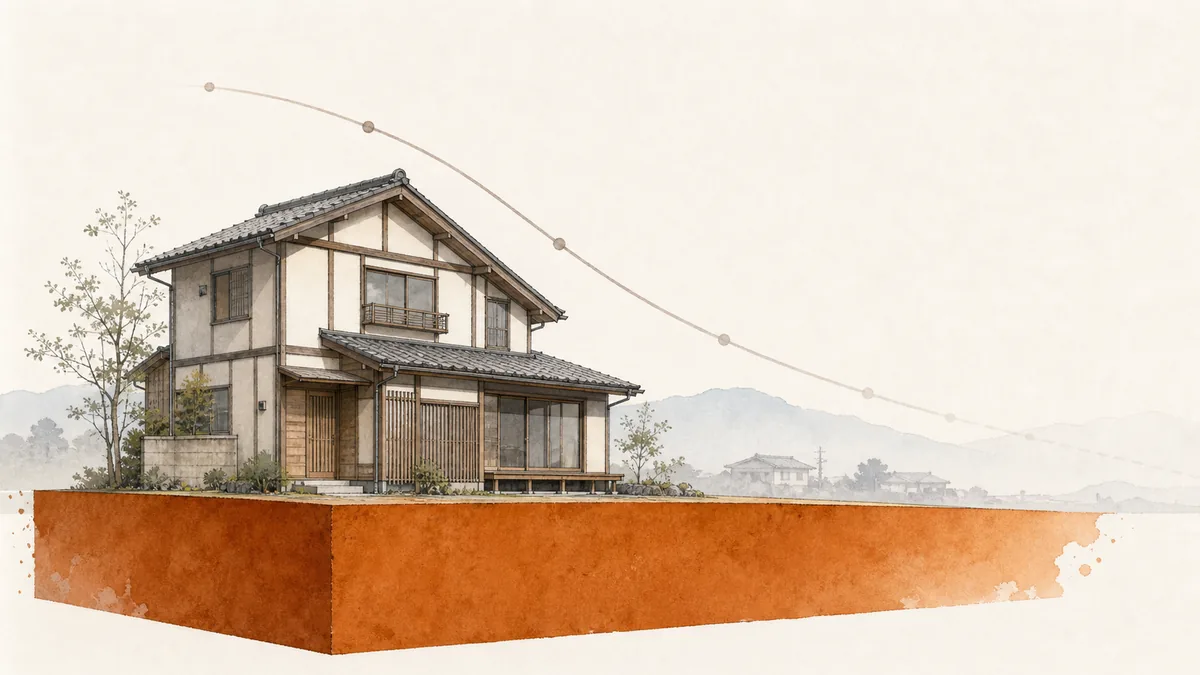
The 22-year number everyone repeats
If you've spent any time reading about Japanese property, you've probably run into the claim that a wooden house is "worthless" after about 20 years. The number usually cited is 22 years for wood-frame houses and 47 years for reinforced-concrete buildings. Both figures are real, but they come from a specific place: the National Tax Agency's statutory useful-life table (法定耐用年数), which exists to standardize how depreciation is calculated for tax purposes, not to certify when a building stops being livable.
A wood-frame house that reaches year 22 hasn't hit an expiration date. It has reached the end of the period over which its original cost can be written off on paper. Plenty of wooden houses in Japan are lived in, well-maintained, and structurally sound decades past that mark, and appraisers, lenders, and tax preparers all know the difference between the statutory schedule and a building's actual physical condition. The confusion happens because the same number gets used loosely in casual conversation, real estate listings, and sometimes by agents who should know better.
A culture built around rebuilding, not reselling
The tax convention alone wouldn't explain why buildings actually behave this way in the market. That has more to do with habit. Much of Japan's housing stock was rebuilt at speed after 1945, and for decades the dominant pattern was straightforward: buy land, put up a new house suited to your own family's needs, and when the next generation takes over, tear down and start again rather than adapt what's there. Reuse of an existing structure was the exception, not the plan.
That habit shaped everything downstream of it — how banks assess older collateral, how agents market a listing, how a seller prices a 25-year-old house. None of it reflects a judgment that older wood construction is inherently unsafe. It reflects a market that, culturally and structurally, has rewarded starting fresh more consistently than markets like the US, UK, or Australia, where renovating and reselling an existing home is the default move.
Where the money actually goes: land, not structure
This is the part that matters most for a buyer, and it's the part casual explanations tend to skip. Japanese valuation practice treats a property's price as two separate components: the land and the building. Fixed-asset tax assessments, bank appraisals, and most agent pricing models split them out explicitly. The building's assessed value tends to fall roughly along that statutory depreciation curve — old house, low or near-zero book value for the structure. The land underneath it is priced on its own terms: location, road access, zoning, and local demand, tracked through published reference prices such as the roadside land price (路線価), which the National Tax Agency values as of 1 January each year and publishes on 1 July.
In practice this means the "house" you're buying and the "land" you're buying can move in opposite directions at once. A 30-year-old house on well-located land in central Tokyo can sell for more than it did a decade ago, even though the building itself is contributing almost nothing to that price on paper. The land did the work.
1981 is the line that resets the clock again
There's a second depreciation-adjacent date worth knowing, separate from the tax table: June 1, 1981. On that date, a revision to the Building Standards Act introduced Japan's current earthquake-resistance standard (新耐震基準), replacing a single-stage check with a two-stage design requirement. Note that the benchmarks are stated in shindo — the Japan Meteorological Agency's seismic intensity scale, which measures how hard the ground shakes at a given place — and not in magnitude, which measures the size of the earthquake itself. The Cabinet Office describes the standard's aim as a building that suffers almost no damage in a moderate quake of roughly shindo 5-strong, and that does not collapse in the sort of severe quake, around shindo 6-strong to 7, that occurs only very rarely. The older standard checked only the moderate case. Whether a building was permitted before or after that date is determined by its building confirmation date, not its construction date, and it has become a real dividing line in how buyers, lenders, and insurers treat older stock.
A house built to the pre-1981 standard isn't automatically dangerous, but it carries a different risk profile, and that shows up in financing terms, insurance premiums, and resale appetite. Combined with the statutory depreciation schedule, it gives Japan's older housing stock two separate reasons to be priced cautiously — one about tax accounting, one about earthquake engineering — that often get blurred together in casual explanations.
A secondhand market that stayed small
Put the tax convention, the rebuilding habit, and the earthquake-code line together, and you get a housing market where existing homes have historically made up a much smaller share of transactions than in comparable economies. A Ministry of Land, Infrastructure, Transport and Tourism (MLIT) policy-evaluation paper puts the existing-home share of total housing turnover — resales plus new housing starts — at 14.5 percent for 2018, against 81.0 percent in the US, 85.9 percent in the UK and 69.8 percent in France. France is worth pulling out of that list: at just under 70 percent it sits well below the two Anglophone figures, though the three are routinely lumped together as "80 percent or more." MLIT's own comment on the 2018 figure is worth quoting against the optimistic version of this story: the share "has not changed greatly compared with 2013, and remains at a low level." Renovation culture and akiya (vacant house) policy attention have grown, but on the ministry's own numbers the gap had not closed, and it remains a structural feature of the market rather than a rounding error.
A thinner resale market means fewer comparable sales, less standardized inspection culture historically, and appraisal habits that default to conservative building values almost as a matter of course. None of that is a flaw in the buildings themselves. It's a reflection of a market that never built the same secondhand infrastructure — inspection norms, renovation financing, buyer confidence — that older housing stock relies on elsewhere.
Where this actually helps you as a buyer
Here's the twist worth sitting with. If a seller's building is expected, by convention, to carry little or no value on paper, you're not being asked to pay a premium for an asset the market assumes will keep appreciating. That's a real difference from housing markets where buyers routinely bid on the story that a 1920s house will keep climbing in value simply because it's old and charming. In Japan, the building's declining book value gives you a legitimate, well-understood basis for negotiating price down as a structure ages, rather than having to argue against a seller's optimism about scarcity or character.
It also clarifies what you're actually protecting. If the land is doing most of the value-holding work, then location fundamentals — transit access, zoning, flood risk, neighborhood trajectory — deserve more of your attention than the cosmetic condition of the building. A tired-looking older house on strong land, priced with the building's depreciation already factored in, can be a rational purchase precisely because you're not overpaying for a structure the market has already agreed is a wasting asset. This is also where the calculus starts to diverge depending on whether you're looking at a house or a condominium unit, since condo buildings depreciate and get revalued differently than land-holding houses — that comparison is covered in more detail in our piece on choosing between a new build and a secondhand condo.
What "well-kept" has to actually mean
None of this is a blanket argument for buying the oldest house you can find. A depreciation schedule tells you what a building is worth on an accounting ledger; it tells you nothing about whether the roof leaks, whether the foundation has settled, or whether a condo building's reserve fund can cover the next major repair cycle. Those are separate questions that require an actual inspection (a home inspection is often called a "住宅診断" or "インスペクション" in Japan), a look at maintenance records, and for condos, a review of the building's long-term repair plan and reserve fund balance.
It also helps to be able to read what you're being shown. Older listings, in particular, tend to come with plans drawn in a shorthand that isn't always intuitive if you didn't grow up with it — room labels, storage notations, and the logic of how a Japanese floor plan is laid out. If that's unfamiliar territory, it's worth working through our guide to reading a Japanese floor plan before you start comparing listings seriously. Depreciation explains why the price looks the way it does. It doesn't replace the homework of confirming what you're actually getting for it.
References
- National Tax Agency (国税庁), "Statutory Useful Life Table for Depreciable Assets — Buildings" (主な減価償却資産の耐用年数表), PDF — wood-frame, shop/residential use: 22 years; reinforced- and steel-reinforced concrete, residential use: 47 years. Accessed 2026-08-02.
- Ministry of Land, Infrastructure, Transport and Tourism (国土交通省), "第3章 既存住宅流通市場の客観的評価" (Chapter 3: Objective Assessment of the Existing-Home Distribution Market), PDF — source of the 2018 shares: Japan 14.5%, US 81.0%, UK 85.9%, France 69.8%. Accessed 2026-08-02.
- Cabinet Office (内閣府), White Paper on Disaster Management 2008 (平成20年版 防災白書), "耐震化の現状" — states the 1981 standard's design targets in shindo: almost no damage at roughly shindo 5-strong, no collapse at shindo 6-strong to 7. Accessed 2026-08-02.
- Japan Meteorological Agency (気象庁), FAQ: "震度とマグニチュードはどう違うのですか?" (How do shindo and magnitude differ?). Accessed 2026-08-02.
- Building Research Institute (国立研究開発法人建築研究所), "「新耐震基準」から40年を振り返る" (40 Years Since the New Earthquake-Resistance Standard), PDF — describes the 1981 revision as a two-stage design check for moderate and severe earthquakes. Accessed 2026-08-02.
- National Tax Agency (国税庁), "No.4602 土地家屋の評価" (Valuation of Land and Buildings) — defines 路線価 as the per-square-metre value of a standard residential lot fronting a given road. Accessed 2026-08-02.
- National Tax Agency (国税庁), 財産評価基準書 路線価図・評価倍率表 (Roadside Land Price Maps) — published annually, valued as of 1 January and released on 1 July. Accessed 2026-08-02.