This article may contain affiliate or sponsored links. Listing order is not a ranking or endorsement. See footer for details.
The Real Cost of Owning a Tokyo Apartment: Taxes, Fees, and the “Kanri-hi” Explained
When you compare listing prices for a Tokyo condominium, known in Japanese as a bunjō mansion (an individually owned unit inside a larger building), it is easy to stop reading once you see the purchase price. But the price tag is only the start. Every unit owner in Japan pays a recurring set of taxes and fees for as long as they hold the property, and those costs can shift meaningfully over the life of the building. This guide walks through what each recurring cost actually is, who charges it, how it tends to change over time, and what you should confirm before you sign anything.
Beyond the Purchase Price
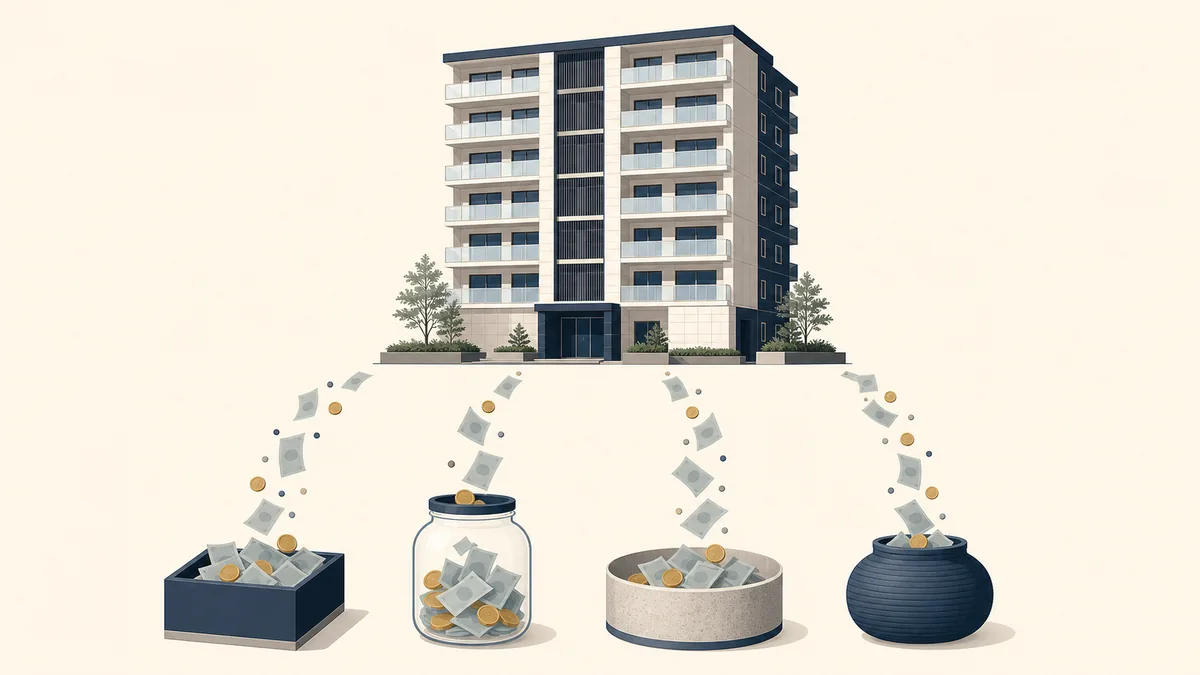
Owning a condominium in Tokyo generally means paying at least four separate, recurring items: a property tax charged by the municipality, a companion urban-planning tax, a monthly fee to your building's management association, and a separate monthly contribution toward future large-scale repairs. Depending on your unit and your lender, you may also carry insurance and, occasionally, a one-time special assessment. None of these are optional extras. They are built into what it means to hold a unit in Japan, and understanding them before you buy is part of the buying process itself.
Fixed Asset Tax (固定資産税, kotei-shisan-zei)
Fixed asset tax is a property tax charged annually to whoever owns land or a building as of January 1 of that year. For a condominium, this covers both your share of the land under the building and your unit itself. In Tokyo's 23 special wards, the tax is administered by the Tokyo Metropolitan Government's Bureau of Taxation rather than by a city government, which is a quirk specific to the wards; outside the 23 wards, your local municipality handles it instead.
The amount is based on an assessed value that the tax authority sets for your property, not the price you actually paid for it. That assessment is not redone annually: values are revalued in full once every three years, in what is called the base year, and in the two intervening years the base-year value is in principle carried over unchanged. So your bill years after purchase will not track the market. The standard rate set in national law is 1.4 per cent of the assessed value, but municipalities may set their own rate, and reductions — for newly built homes, for small residential land — change the figure that actually lands on the notice. Treat any percentage you see online as a starting point, and confirm the current framework with the tax authority or a licensed professional before you budget around it.
City Planning Tax (都市計画税, toshi-keikaku-zei)
City planning tax is billed alongside fixed asset tax, on the same notice. The catchment is narrower than the name suggests in English: the tax applies to land and buildings inside an urbanisation promotion area (市街化区域) — the zone within a city planning area that is designated for development — rather than to every property inside a city planning area. Most of central Tokyo falls inside it, but the distinction matters at the edges of the metropolitan area. It funds infrastructure such as roads, water systems, and parks in the surrounding district.
National law caps the rate at 0.3 per cent and leaves the local authority to set it within that ceiling. In the 23 wards the rate applied is 0.3 per cent — the ceiling itself — with the Metropolitan Government granting its own reduction on small residential land, currently halving the tax on the first 200 m² per dwelling. Outside the wards, check the municipality's own figure rather than assuming Tokyo's applies.
The Monthly Management Fee (管理費, kanri-hi)
The management fee, or kanri-hi, is a separate monthly charge that has nothing to do with taxes. It is paid to your building's management association, called the kanri kumiai (管理組合) in Japanese, which is made up of the unit owners themselves, even though day-to-day operations are usually outsourced to a management company. Kanri-hi covers the ordinary running costs of the building: cleaning of common areas, elevator servicing, lighting and utilities for shared spaces, front-desk staffing if the building has one, and the management company's own fee.
Kanri-hi is set out in the building's management bylaws, called the kanri kiyaku (管理規約), and is reviewed periodically by the management association rather than by an outside authority. It can rise over time, particularly if the building adds services, if the management company renegotiates its contract, or if the pool of paying owners shrinks because units sit vacant. Before you commit to a unit, ask to see recent kanri-hi statements and minutes from management association meetings; they will usually show whether fees have been climbing and why.
The Repair Reserve Fund (修繕積立金, shūzen-tsumitate-kin)
Separate again from kanri-hi is the repair reserve fund, or shūzen-tsumitate-kin, a monthly contribution set aside specifically for large, infrequent repair work: waterproofing the roof, repainting and repairing the exterior, replacing shared piping, and similar projects known collectively as daikibo shūzen kōji (大規模修繕工事, large-scale repair work). This fund is held separately from the operating budget and, in a well-run building, is not spent on day-to-day expenses.
Japan's Ministry of Land, Infrastructure, Transport and Tourism publishes guidelines for how associations should plan and fund these long-term repair plans, called chōki shūzen keikaku (長期修繕計画). The guideline asks for a plan spanning at least thirty years and covering at least two rounds of large-scale repair work — which is a useful yardstick when you are handed one: a plan that stops well short of that is not the full picture.
Many buildings set contributions to rise in steps over the building's life rather than staying flat — the 段階増額 method. It is common, particularly in newer buildings, but it is worth being clear that the ministry does not treat it as the preferable arrangement. Its guidance says plainly that for securing a stable reserve over the long run, the flat method (均等積立方式), where the whole plan period is levelled out, is the desirable one; that methods relying on future increases have in practice led to shortfalls when owners could not agree to the increase when the time came; and that where the stepped method is used, the increases should be completed early. The ministry has gone as far as publishing a leaflet urging buildings on the stepped method to switch. So when you see a low monthly reserve on a listing sheet, the question is not whether it will rise — it is whether the plan that raises it has been agreed, and whether the owners will actually vote for the rise. Older buildings often carry higher monthly contributions than newer ones for exactly this reason, which is one of several tradeoffs worth weighing when you compare a new-build unit against a secondhand one.
Occasional Lump-Sum Levies (一時金, ichijikin)
If a building's reserve fund falls short of what a planned repair actually costs, the management association can call for a one-time levy on owners on top of their regular monthly contribution — 一時金, or in the language of the model bylaws, a 一時負担金. The model bylaws contemplate both routes out of a shortfall: the association may ask owners for the necessary sum in proportion to their shares, and it may borrow, repaying the loan out of the reserve. The ministry's English guidance for foreign unit owners puts the risk plainly: where a sufficient reserve has not been accumulated, the result "may lead to sudden lump-sum collections or delays in repair work." This is more likely in older buildings with underfunded reserves, or in associations that have deferred raising contributions for years. Before buying, ask whether the building has ever levied one and whether one is currently being discussed.
Insurance You'll Likely Need
Expect to carry fire insurance, kasai hoken (火災保険), on the interior of your own unit. Where a mortgage is involved this is often not a suggestion: the Japan Housing Finance Agency, the public institution behind Flat 35, requires a borrower to keep fire cover on the building for the whole life of the loan, and private lenders commonly impose their own requirement — ask yours what it is rather than assuming.
Earthquake insurance, jishin hoken (地震保険), is genuinely a rider and not an alternative. Under the national scheme it cannot be bought on its own: it is written as an attachment to a fire policy, so a fire policy is the precondition, although it can be added part-way through an existing contract. This matters more here than it would elsewhere, because an ordinary fire policy does not cover fire caused by an earthquake. Coverage for the building's structure and common areas is a separate matter, arranged by the management association — the model bylaws list common-area fire and earthquake premiums among the things kanri-hi pays for — but exactly where that split falls varies by building, so confirm it directly.
If You're Considering a Leasehold Unit
Everything above assumes you own the land under the building outright, or a fractional share of it, which is the arrangement for most bunjō mansion purchases. Some units, however, sit on leasehold land, where you own the building but pay ground rent to a separate landowner. Ground rent is its own recurring cost, on top of everything described here, and it behaves differently from the items above. If a listing mentions leasehold land, read leasehold vs freehold in Japan before going further, since the ongoing math changes substantially.
A Quick Reference Table
The table below summarizes each recurring cost. It is meant as an orientation, not a quote. Actual figures depend on your specific property, its assessed value, its management association's decisions, and the year in question.
| Cost item | What it is | Who charges it | How it tends to behave |
|---|---|---|---|
| Fixed asset tax (固定資産税) | Annual property tax on land and building; standard rate 1.4% of assessed value | Tokyo Metropolitan Government (23 wards) or the local municipality elsewhere | Revalued every third year (the base year); not tied to your purchase price |
| City planning tax (都市計画税) | Companion tax for property inside an urbanisation promotion area (市街化区域) | Same authority as fixed asset tax, billed together | Capped at 0.3%; applied at 0.3% in the 23 wards. Moves with the same reassessment cycle |
| Management fee (管理費, kanri-hi) | Funds day-to-day building operations | The building's management association | Reviewed periodically; can rise with added services, contract changes, or vacancy |
| Repair reserve fund (修繕積立金) | Funds large, infrequent repair projects | The building's management association | Often rises in planned steps as the building ages |
| Insurance | Covers your unit's interior and, separately, common areas | You arrange unit-level coverage; the association typically arranges common-area coverage | Depends on policy terms and building age |
| Special assessment (一時金, ichijikin) | One-time levy when reserves fall short of a repair's actual cost | The building's management association | Occasional and situational, not scheduled |
What to Check Before You Commit
A few habits will save you from unpleasant surprises after you take ownership:
- Ask for the building's current long-term repair plan (chōki shūzen keikaku) and the reserve fund's balance against that plan, not just the current monthly contribution.
- Ask whether kanri-hi or the reserve contribution has increased over the past five to ten years, and by how much.
- Ask whether the building has ever levied a special assessment, and whether one is being discussed.
- Check the delinquency rate among current owners; a building with many owners behind on payments can signal deeper financial strain. This is a tracked national problem, not an exotic worry — the ministry's five-yearly Condominium Comprehensive Survey reports on how associations handle arrears.
- Confirm your likely fixed asset tax and city planning tax exposure with the relevant tax office or a tax accountant, since assessed value is unit-specific.
- Have a judicial scrivener confirm the registered ownership share of land tied to your unit, since this affects your portion of shared costs.
- If the building is older, weigh these figures against a comparable new-build unit, where reserve contributions typically start lower but rise on a different schedule.
None of this replaces professional advice. A 宅建士 (takken-shi, licensed real estate transaction agent), a 税理士 (zeirishi, tax accountant), and a 司法書士 (shihō shoshi, judicial scrivener) can each confirm the parts that apply to your specific purchase, and their answers will be more current than any general guide. What you can do on your own is ask the right questions early, before the recurring costs become a surprise instead of a plan.
References
- 総務省 (MIC) — 固定資産税の概要 (Fixed Asset Tax overview). Accessed 2026-08-02.
- 総務省 (MIC) — 都市計画税 (City Planning Tax overview). Accessed 2026-08-02.
- 東京都主税局 (Tokyo Metropolitan Government Bureau of Taxation) — 固定資産税・都市計画税(土地・家屋). Accessed 2026-08-02.
- 国土交通省 (MLIT) — 住宅:マンション管理 (Condominium Management: standard bylaws + long-term repair plan guidelines). Accessed 2026-08-02.
- 地方税法 (Local Tax Act) — Art. 350 (1.4% standard rate), Art. 359 (January 1 assessment date), Art. 341(vi) and 349 (three-year revaluation cycle), Art. 702 (city planning tax applies within an urbanisation promotion area) and Art. 702-4 (0.3% ceiling). Text read via the e-Gov law API. Accessed 2026-08-02.
- 国土交通省 — 長期修繕計画作成ガイドライン (Long-term Repair Plan Guideline, PDF): a plan period of thirty years or more, covering at least two rounds of large-scale repair. Accessed 2026-08-02.
- 国土交通省 — マンションの修繕積立金に関するガイドライン (Guideline on Condominium Repair Reserves, PDF): the flat contribution method is the desirable one; stepped increases have produced shortfalls where owners could not agree to the rise. Accessed 2026-08-02.
- 国土交通省 — マンション標準管理規約(単棟型・コメント付き, PDF): Art. 27 (what kanri-hi covers, including common-area fire and earthquake premiums), Art. 28 (the reserve may be drawn only for special management), Art. 61(2) (owners may be asked for the shortfall) and Art. 63 (borrowing). Accessed 2026-08-02.
- MLIT — For Foreign Unit Owners: Condominium Management in Japan (English, PDF). Accessed 2026-08-02.
- 国土交通省 — 令和5年度マンション総合調査 (FY2023 Condominium Comprehensive Survey). Accessed 2026-08-02.
- 財務省 (Ministry of Finance) — 地震保険制度の概要: earthquake insurance is written as an attachment to a fire policy and cannot be held on its own. Accessed 2026-08-02.
- 住宅金融支援機構 (Japan Housing Finance Agency) — 火災保険・地震保険のご案内: fire cover is required on the building until the loan is repaid. Accessed 2026-08-02.