This article may contain affiliate or sponsored links. Listing order is not a ranking or endorsement. See footer for details.
A City Is a Building at Street Scale: Reading Japanese Urban Planning
Buyers photograph the view from the balcony. I photographed the garbage room. After a working life spent tending Tokyo condominiums, I learned that a building tells the truth in the places no listing photo shows — the bicycle racks, the mail slots, the worn notice board by the elevator. What I did not expect, once I set the keys down, was to find that a city reads exactly the same way. The stops are bigger. The order is the same. And most people walk straight past every one of them.
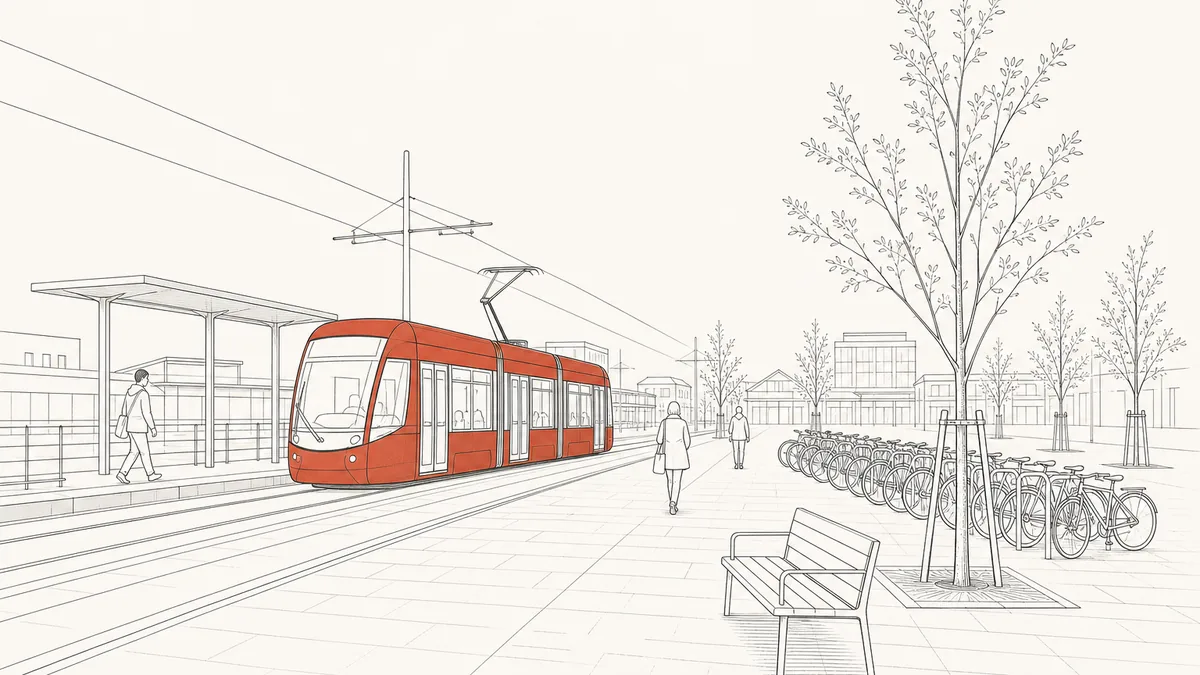
A city has the same organs as a building
Let me be honest about who is talking to you. The kanrinin — the building superintendent — in these pages is a composite, thirty years of other people's buildings compressed into one dry old man. The walks are generalized, not any single job I can point you to. But the method is real enough, and it survives the move from one building to a whole city without changing shape.
In a condominium there were four things I always read before I trusted the glossy parts. The shared spaces you can walk. A notice board that tells you what the management is actually doing rather than saying. A management association that decides and pays. And a long-term repair plan (長期修繕計画) — the document that says where the building's money goes over the decades ahead. The ministry's guideline puts a floor under it: thirty years at least, and long enough to contain two rounds of large-scale repair work. Fewer years than that and you are not looking at the whole cycle. A city has all four organs. Its shared spaces are the station square, the parks, the sidewalks. Its notice board is the municipal newsletter and the literal boards outside the city office. Its management association is the local government. And its long-term repair plan exists in writing, because the City Planning Act says it must: a municipality is to adopt a basic policy for its city planning — the document everyone calls the city master plan (都市計画マスタープラン, toshi keikaku master plan) — and, once adopted, to publish it without delay. The Act does not fix how many years it must cover; in practice these plans look out a decade or two. What matters is that it exists and that you can read it.
Here is the quiet part. A condominium publishes its repair plan and hopes the owners read it. A city publishes its master plan and knows that almost no resident ever will. Reading a plan is a skill — the same eye that lets you decode a Japanese floor plan lets you decode a city plan — and skipping it means you are trusting the paint. So let me show you two cities where the paint and the plumbing tell different stories, and then the walk I would have you take yourself.
Nagareyama: the slogan is the paint, the send-off station is the plumbing
The first is Nagareyama, in Chiba, out to the north-east. For most of its life it was a quiet place that people passed through on the way to somewhere louder. Two decisions, both made in full public view, changed that. First, in August 2005 the Tsukuba Express line opened and put Nagareyama roughly twenty-five to thirty minutes from Akihabara — close enough to commute into the center, far enough to breathe out of it. Second, and this is the part I admire, the city decided who it wanted and said so out loud. It marketed itself, explicitly, to dual-income families raising small children. Its slogan — roughly, "If you're going to become a mother, Nagareyama" — became one of the most famous pieces of municipal branding in Japan. The city runs it as a pair, incidentally, and the second half gets quoted far less often: if you're going to become a father, Nagareyama.
A slogan is paint. Anyone can paint. What told me Nagareyama meant it was the plumbing behind the words: station-front childcare "send-off" stations. There are two of them, both at the foot of a Tsukuba Express station, and the arrangement is this: a parent on the way to the train drops the child there, and a bus carries the child out to the licensed nursery it is already enrolled at — the scheme covers nurseries more than 500 metres from the station, which are precisely the ones a commuting parent cannot reach twice a day. Morning only, evening only, or both. It does not conjure a nursery place out of nothing; the city is careful to tell parents to choose a nursery they could reach themselves. What it does is remove the detour. That is not a poster. That is logistics — someone costed it, staffed it, and keeps it running every single morning, rain included. Through the late 2010s and into the 2020s the city repeatedly ranked among Japan's fastest-growing by population growth rate. I will not quote you a figure, because the figure moves and you should read the current one yourself. The lesson is older than any of the numbers: judge a building by whether the promises on the notice board are backed by pipes in the wall. Judge a city the same way. The slogan is the paint. The send-off station is the plumbing.
Utsunomiya's Lightline: rail laid where people actually work
The second city is Utsunomiya, in Tochigi, up to the north. On 26 August 2023 it opened the Lightline, and the city's own portal is careful to claim two separate things about it, which are worth keeping separate. One: it was the first new tram line to open anywhere in Japan in seventy-five years. Two — the rarer one — it is the first time in the country that a town with no tram at all has had one built for it from nothing, rather than inheriting a survivor of the old streetcar age. The line runs about 14.6 kilometres east from the station, out to an industrial estate, and it is double-tracked the whole way.
What I notice is not that the trams are shiny. New things are easy to admire and easy to waste; I have watched plenty of freshly renovated lobbies sit above an empty repair fund. What I notice is where they put the rail: toward the places its residents actually go to work, not toward a photogenic waterfront that films well and serves no one on a Tuesday. And the numbers have followed. I do not have to say "reported" here, which is unusual and worth savouring: the operating company's own results for the 2024 financial year put ridership at 5.122 million against the 3.923 million written into the statutory plan — thirty per cent above what the plan promised. Westward, across the station to the other side of the city, the extension has moved past hopeful talk: in October 2025 the city put a draft implementation plan in front of its council with a target opening of March 2036 and an estimated construction cost of ¥69.8 billion. That is still a target and not a train, and a decade is long enough for a plan to change its mind — check it against the city's own announcements rather than against this page.
A city that lays rail where its people work, and argues the budget line by line in council meetings anyone may sit in on, is doing maintenance, not decoration. And the development follows the maintenance. Shops, clinics, and homes cluster near the stops the way well-kept mailboxes cluster near a notice board that somebody actually tends. You do not need me to name a stop. You need to know that the clustering is a signal, and to go and read where the next stops are going.
A superintendent's walk, at city scale
I never trusted my impression of a building. I trusted a route. The same five stops in the same order, every time, so that I compared like with like and my mood did not get a vote. Here is that walk, scaled up to a city. You can do the first three with your own feet on a Saturday; the last two you do from a library chair with the documents open.
| City signal | The building equivalent | Where to read it |
|---|---|---|
| The station square at 7 a.m. | The entrance lobby someone actually owns | Stand there on a weekday morning. Swept ground, working lights, tended planting, signage that is not broken — or none of it |
| The bicycle parking | The bike racks and shared storage | Walk the racks. Order means the rules are enforced and the demand is real; chaos means one or both are missing |
| The public notice board / city newsletter | The board by the elevator | The municipal newsletter and the boards outside the city office. What is the city telling residents — a new school, sewer work, a festival? |
| The long-term repair plan | The condo's 長期修繕計画 | The published city master plan (都市計画マスタープラン) — the Act requires it to be adopted and published. Where does the city say it will spend over the coming decade or two — rail, schools, flood control? |
| The money | The repair-reserve balance | Municipal finance indices are published. A city investing while solvent is not the same as one decorating while hollow. Keep it general and read the official figures |
The first three stops you read with your body. Order at the bike racks, lights that work in the station square, a notice board thick with real business — those are the marks of a place that is being tended by someone who has to live with the consequences. The last two you read with documents, and they are exactly where the amateurs stop and the careful keep going. A city can look tended for a photograph and be quietly hollow underneath, the same way a lobby gets polished the week before a viewing. The pipes and the ledger do not pose for anyone.
What the walk does not tell you
Now the part I would want someone to say plainly to me. None of this predicts a price. A city can pass every stop on my walk and still be the wrong city for you — wrong commute, wrong schools, wrong for the life you actually lead rather than the one in the brochure. This is a way of reading, not investment advice, and it is not a forecast of what anything will be worth. I have named two cities because they are publicly known worked examples, not because you should buy into them; a signals framework is the opposite of a shopping list.
Everything here changes, too. Master plans get revised, rail extensions slip, and a slogan can outlive the budget that once stood behind it. Verify the current version on the municipality's own official site. And when you move from reading a city to buying a specific home inside it, that is where the licensed professionals take over: a licensed real estate agent (宅建士) gives the legally required explanation of a property before you sign, a judicial scrivener (司法書士) handles title, and a tax accountant (税理士) handles the tax. Read the city yourself. Leave the transaction to them. Once you are down to a single property, the homework has a checklist of its own — start with the pre-contact due diligence checklist before you email anyone.
The garbage room and the station square
Here is the picture I would leave you with. In a building, I could tell you more from five minutes in the garbage room than from an hour in a staged model unit, because the garbage room never lies — it shows you whether the residents and the management actually keep the promises pinned to the notice board. A city's garbage room is its station square at seven in the morning, its bicycle racks, its master plan, and its published accounts. The balcony view is the model unit. Both are worth a look. Only one of them tells you who will be living with the repair bill twenty years from now. And once you have read the city around it, a single neighborhood is worth walking slowly and at eye level too — see picturing daily life in a Tokyo neighborhood.
A superintendent's short walk, before you fall for a city
- Stand in the station square on a weekday morning. Swept, lit, tended — or not?
- Read the bicycle racks. Order is enforcement plus real demand; chaos is the absence of one.
- Read the notice board and the city newsletter. What is actually being built, fixed, or funded?
- Open the city master plan (都市計画マスタープラン). Where does the money go over the next 10–20 years?
- Glance at the published municipal finances. Investing while solvent, or decorating while hollow?
- Only then look at a specific home — and hand the transaction itself to a licensed professional (宅建士).
Official sources
- Nagareyama City (official, Japanese) — 送迎保育ステーションのご案内, the page describing how the shuttle scheme actually works, including the 500-metre rule and the advice to choose a nursery you could reach yourself. city.nagareyama.chiba.jp
- Nagareyama City (official brand site, Japanese) — the slogan in its full paired form, 母になるなら、流山市。父になるなら、流山市。 brand.city.nagareyama.chiba.jp
- Utsunomiya City — Lightline official portal (Japanese), which states both claims made above: the first new tram opening in Japan in seventy-five years, and the country's first LRT built for a town that had no tram. u-movenext.net · the westward extension section is at u-movenext.net/westside
- Utsunomiya Light Rail Co. (operator, official, Japanese) — 会社概要, giving the 14.6 km double-tracked route from Utsunomiya Station East to the Haga–Takanezawa industrial estate. miyarail.co.jp/corporate
- Utsunomiya Light Rail Co. — FY2024 results summary (PDF, Japanese): ridership of 5,122 thousand against the 3,923 thousand in the statutory plan. miyarail.co.jp (PDF)
- Utsunomiya City — draft implementation plan for the westward extension, 20 October 2025 (PDF, Japanese): target opening March 2036, estimated construction cost ¥69.8 billion excluding tax. city.utsunomiya.lg.jp (PDF)
- 首都圏新都市鉄道 (Tsukuba Express, official, Japanese) — line overview giving the opening date of 24 August 2005. mir.co.jp
- 都市計画法 第18条の2 (City Planning Act, Art. 18-2) — the requirement that a municipality adopt and publish a basic policy for its city planning. Text read via the e-Gov law API. laws.e-gov.go.jp
- 国土交通省 — 長期修繕計画作成ガイドライン (PDF, Japanese): a plan period of thirty years or more, covering at least two rounds of large-scale repair. mlit.go.jp (PDF)
- 総務省 (MIC) — where the municipal finance figures actually live: 地方公共団体の主要財政指標一覧 and 財政状況資料集
- Ministry of Land, Infrastructure, Transport and Tourism (MLIT / 国土交通省, English) — the ministry behind Japan's city-planning system. mlit.go.jp/en/toshi