This article may contain affiliate or sponsored links. Listing order is not a ranking or endorsement. See footer for details.
Winter Is the Building Inspector: Reading Hokkaido Property
Buyers photograph the view from the balcony. I photograph the garbage room. That habit came from a working life as a kanrinin — a building superintendent — in Tokyo, thirty years I'll tell you plainly is a composite of many, because that is the honest way to tell it. I never worked a single winter in Hokkaido. But the northern buildings, and the people who tended them, taught me one thing Tokyo never could: up there, you do not need my eye to inspect a building. Winter does it for you, six months a year, without an appointment. Your only job is to read the report it leaves behind.
Why Hokkaido reaches a screen in another country
There are reasons a person somewhere far away ends up typing "Hokkaido property" into a search bar at all, and I will keep them short, because they are not my trade. The resort economy around the Niseko area turned a stretch of Hokkaido into an international phrase. Sapporo's station district has a large redevelopment tied to a planned Shinkansen extension, and that extension has slipped a long way. The 2030 target came from a 2015 government-and-ruling-party agreement; in May 2024 the railway agency reported to the transport minister that meeting it had become extremely difficult, and the expert panel that followed published, in March 2025, an outlook of "around the end of fiscal 2038" — while saying in the same breath that further delay of several more years is possible, that considerable uncertainty remains, and that the opening date should properly be fixed only once the tunnelling is closer to done. Treat any date you are quoted as a working assumption, not a promise, and read the agency's own releases rather than a stranger's summary. And near Chitose, a major semiconductor project has moved past the building stage: its pilot line began operating in 2025, with mass production targeted for 2027. I have no figures for any of it, and no forecast to sell you.
Here is what all three have in common. None of them tells you a single true thing about the building you are actually standing in. A regional headline cannot hear a boiler that struggles on a cold night. It cannot see where a roof drops its snow. Winter can. So let me walk you through the shared spaces the way I always did — in a fixed order, one thing to check at each stop — except up here, the inspector arrived before we did.
The roof is a decision, not a shape
In Tokyo I read roofs for leaks. Colleagues who worked northern buildings taught me to read them for where a winter's worth of snow is meant to go, because it has to go somewhere, and "somewhere" is usually a question of whose property it lands on. A pitched roof sheds — that is its whole design, to let the snow slide off. So stand under the eave and ask the plain question: when a metre of accumulated snow finally lets go, where does it land? If the answer is the neighbor's fence, their parking space, or the path someone walks to work each morning, that is not a detail. In snow country it is the seed of a dispute, and disputes have a way of outliving the owners who started them.
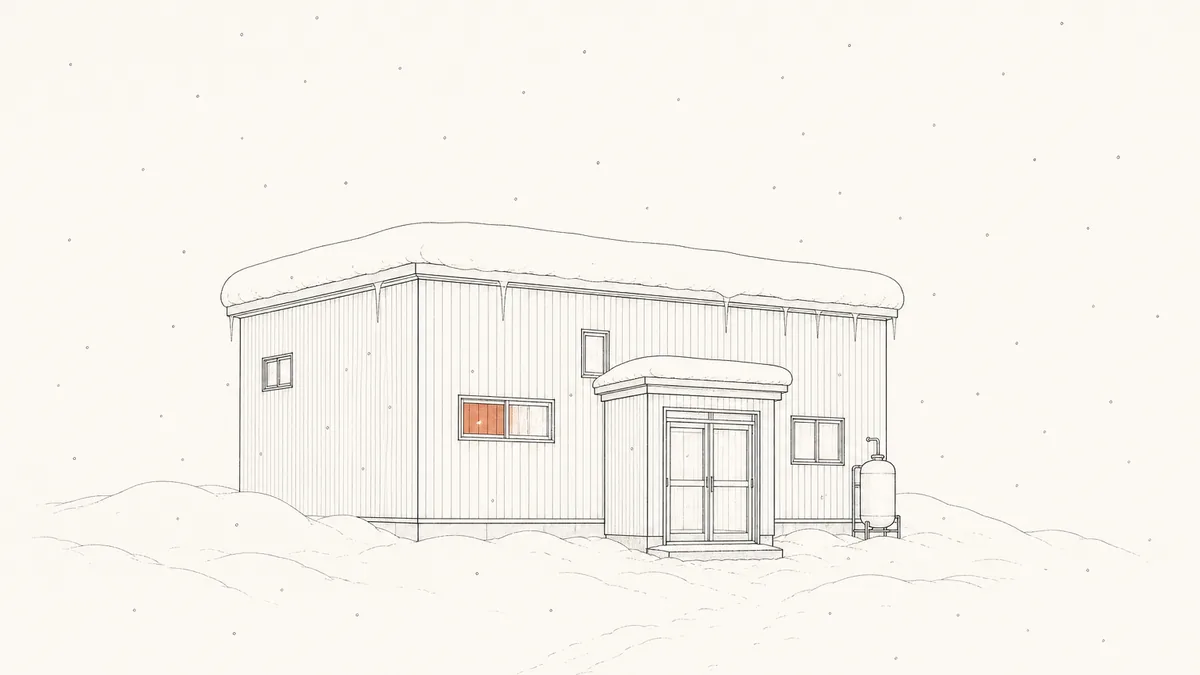
Then there is the roof that does not drop its snow at all — 無落雪屋根, the no-drop kind, which is not a curiosity up there but the norm: Hokkaido's prefectural research institute puts it at 55% of new houses in the prefecture. It solves the falling-snow problem by keeping the snow where it lands, and it hands you a different set of questions in exchange. The institute lists them plainly: snow cornices at the edge, the sheer weight of a heavy winter's accumulation sitting on the structure, and second-floor windows and equipment buried by it — problems whose answer, in the end, is still somebody getting up there and clearing it. So ask who does that, how often, and at whose cost, and do not assume the answer is nobody.
Then look at the icicles, and read them more carefully than I used to. A heavy curtain hanging off a roof edge can mean heat is escaping where it should not, melting snow that refreezes at the cold lip — that was my Tokyo reading of them, and it is often right. But the same research institute notes that melting the snow on a roof deliberately produces icicles too, along with the energy bill for doing it. So the ice tells you that snow is being melted; it does not, on its own, tell you whether that was the building's intention or its failure. Ask which.
Heat is the building's heartbeat
In a Tokyo building I could pass a whole winter barely thinking about the heating plant. Up north it is the organ every other comfort depends on, and I learned to ask after its health first. Some buildings run a central boiler for the whole block. Some burn kerosene drawn from a tank that must be refilled through the season — which means someone has to reach the tank, and the delivery has to reach the door, and both of those are harder in February than any listing photo lets on. In the centre of Sapporo and a few other districts — the city's own climate plan says so — there is district heating, piped in from outside the building entirely. None of these is better or worse in the abstract. What matters is which one you are buying, and how old it is.
The age of the boiler is a repair bill forecast in plain sight, so find it. A plant near the end of its life is a cost walking steadily toward every owner, and in a condominium it is a cost you will share whether or not you voted for it. Then do the one thing a photograph can never do for you: ask what last winter's heating actually cost. The bills exist. A real number for a real winter beats any estimate a cheerful description offers. Ask for it, read it, and if nobody will produce it, treat that silence as information too.
The vestibule, the boiler room, and the meter box
Every building I ever tended had a place that told the truth when the lobby was busy lying, and in Tokyo that place was the garbage room. The garbage room never lies. In Hokkaido the truth-telling rooms are three, and I walk them in order.
First, the vestibule. Northern entrances often have a double door — a small windbreak room, a fusetsu-shitsu, set between the outside and the inside so the cold and the blowing snow are caught before they reach the hall. It is standard anatomy up there, and it will be marked on the floor plan if you know to look; if those diagrams are still a foreign alphabet to you, my note on reading a Japanese floor plan is where to start. Its condition tells you whether the building was designed for its climate or merely dropped into it.
Second, the boiler room, which we have already stood in — note the age, listen to how it runs, and remember that it warms everything downstream of it.
Third, the meter box, and here is where a vacant home gives itself away. In snow country a house left empty in deep winter will freeze its own pipes unless the water is drained out of them first. That draining is a real, named procedure — mizu-nuki — and a properly closed-up house has had it done. An akiya, an empty house, that has sat through a winter or two without it can be cheap for reasons no listing photograph will ever show you, because burst pipes hide inside the walls. The same before-you-write homework I set out in the pre-contact due diligence checklist applies double here: the questions you write down standing at the meter box are the ones that save you. Ask whether the property was winterized, by whom, and for how long it has stood.
The winter line items in the association's books
In a condominium the management association keeps books, and in Hokkaido those books carry lines a Tokyo building never needed. Read them. Somewhere in the budget is snow work — the clearing of it and the hauling of it away, which are two different jobs and sometimes two different bills. Ask who clears the parking lot, and how often, because a lot nobody clears is a lot you cannot park in. Ask how the roof gets inspected, and on what schedule, because a no-drop roof carries its snow all winter and needs eyes on it before the thaw, not after.
Then find the long-term repair plan and see whether it is honest with itself. A plan that prices the roof membrane and the eventual boiler replacement at real numbers is a building looking its own future in the eye. A plan that pretends those costs will never arrive is a lump-sum assessment waiting to be born. This is the same arithmetic I laid out for buyers weighing a new build against a secondhand condo, only with a heavier winter thumb on the scale.
If it is a house rather than a condo, the association does none of this for you, so you inherit the questions yourself. Who is responsible, in writing, for clearing the sidewalk out front? And whose problem is the roof edge that faces the neighbor — the one that sheds onto their side of the line? In snow country those are not pleasantries. They are contract terms, and I would want them settled in writing before I wanted almost anything else.
What the snow cannot tell you
I have spent this whole walk telling you what winter reveals, so let me be just as plain about what it does not. It does not tell you what a property is worth, and neither do I — there is no investment advice in this article, and no price prediction anywhere in it. A resort-area market and a city market behave like two different animals; I am ranking neither, and recommending no building, no developer, and no resort. Winter is an honest inspector of concrete and pipe and roof. It is silent on law, on tax, and on money, and anyone who tells you otherwise is selling something.
For those matters you go to people licensed to answer them. Verify anything current — a development timeline, a boundary, a building's registered facts — against official sources, and transact only through a licensed real estate agent, a takken-shi (宅建士), who is bound to give you the required explanation of a property's important matters before you sign. For the regional picture behind all of this — the plans, the hazard maps, the local rules — the prefectural and municipal governments publish it themselves, and their word is the one that counts.
The one inspector who never misses an appointment
I trusted the garbage room in Tokyo because it could not flatter anyone. Hokkaido handed me a larger version of the same honest friend. Winter does not care what the listing says. It does not care about the view. Six months a year it walks every building, tries every roof, tests every pipe, and leaves its report in ice and standing water and heating bills for anyone patient enough to read it. It is the one inspector that never cancels and never misses an appointment. Learn its handwriting, and go stand in the cold rooms before you sign anything warm.
The cold-rooms checklist
- Roof type and drainage — pitched, or 無落雪 (no-drop), and exactly where the snow is meant to go.
- Boiler age and fuel — central, kerosene, or district heat, and the year it was installed.
- Last winter's heating bills — request the actual figures; do not accept an estimate.
- Vestibule and meter box — the windbreak room and the plumbing that a listing photo flatters.
- Winterization history if vacant — was the water drained (mizu-nuki), by whom, and for how long has it sat?
- Snow-removal line items — who clears, who hauls, and does the repair plan fund the roof and boiler realistically?
- Who owns the snow's landing spot — whose property does the roof shed onto, and is it settled in writing?
Official sources
- Hokkaido Research Organization (道総研), 第10話 屋根雪対策 — the source for no-drop roofs being 55% of new houses in Hokkaido, for the snow-load, cornice and burial problems they bring, and for the point that melting roof snow itself produces icicles. hro.or.jp
- Japan Railway Construction, Transport and Technology Agency (JRTT), 北海道新幹線(新函館北斗・札幌間)— the 2030 target, the May 2024 report that it had become extremely difficult, and the March 2025 expert-panel outlook of "around the end of fiscal 2038". jrtt.go.jp
- National Diet Library, 調査と情報 ISSUE BRIEF No. 1330, ラピダスをめぐる動向 (9 September 2025, PDF) — the Chitose pilot line starting in April 2025 and the 2027 mass-production target. dl.ndl.go.jp (PDF)
- Sapporo Waterworks Bureau, 水道を凍結させないためには — the water-draining procedure (水抜き) this article calls mizu-nuki, with the step-by-step method. city.sapporo.jp
- City of Sapporo, 冬の暮らし・除雪 — snow clearing and snow haulage as separate programmes with separate cost-sharing. city.sapporo.jp
- City of Sapporo, 気候変動対策行動計画 (PDF) — confirms district heating is in use in the city centre and several other districts, not city-wide. city.sapporo.jp (PDF)
- Hokkaido Prefectural Government (official, Japanese) — regional plans, disaster information, and local rules across Hokkaido. pref.hokkaido.lg.jp